Beginner
Decrypting the Traffic Code: What is 'Internet Sense'? How to Make 'Good Content' Go Viral, Even a Fart Can Get 100K+
Decrypting the Traffic Code: What is 'Internet Sense'? How to Make 'Good Content' Go Viral, Even a Fart Can Get 100K+
Decrypting the Traffic Code: What is 'Internet Sense'? How to Make 'Good Content' Go Viral, Even a Fart Can Get 100K+#
Why does nobody watch your good content? Others can get 100K+ just by complaining.
You stayed up late writing a piece of solid content, pulled out a small clump of hair in the process, only to see the view count not even break a hundred. Deeply discouraged, you ask yourself while staring at the dismal readership: "Why does no one read the content I poured my heart and soul into?"
After three months of bitter writing on a public account with reads not breaking a hundred, I started deconstructing content from high-read accounts. I discovered that in this era of scarce attention, the essence of traffic is not information transmission, but emotional resonance.
Users open their phones not to attend a class, but for entertainment, to find some psychological comfort in their exhausting lives. Even solid, informative content needs to be wrapped in the cloak of emotional resonance to spread widely.
If you want to carve a path through this bloody sea, you must master a core ability that all top creators secretly possess but never talk about—"Internet Sense."
This article will completely tear off the disguise of "Internet Sense" for you and share a set of deliberate practice methods I've used for two years—methods that are effective, practical, and produce results—allowing you to truly master the traffic code for explosive content from scratch.
- Re-understanding "Internet Sense": The Essence of Traffic is About Emotion
"Internet Sense" sounds mysterious, like a kind of talent. Cut the nonsense. It's not a talent; it's a hard skill that can be acquired later. To master it, you must first see through the platform logic and user psychology behind it.
1.1 The True Meaning of "Internet Sense": "Reading the Room" in the Online World
Forget those complex definitions. My understanding is: "Internet Sense" is "reading the room" in the online world.
It's a hardcore survival skill. When a public event occurs, you must, like a seasoned people-pleaser, instantly judge the emotional trend of the online masses:
● Are they scared out of their wits, looking for someone to pull them up? Or are they furious, looking for a target to vent at?
● Do they need a gentle lullaby ("Sweetie, don't be afraid") or a resounding slap ("You idiot, cut your losses now!")? Once you see through this, you can, like a surgeon, precisely hit the public's emotions and leverage traffic that doesn't originally belong to you.
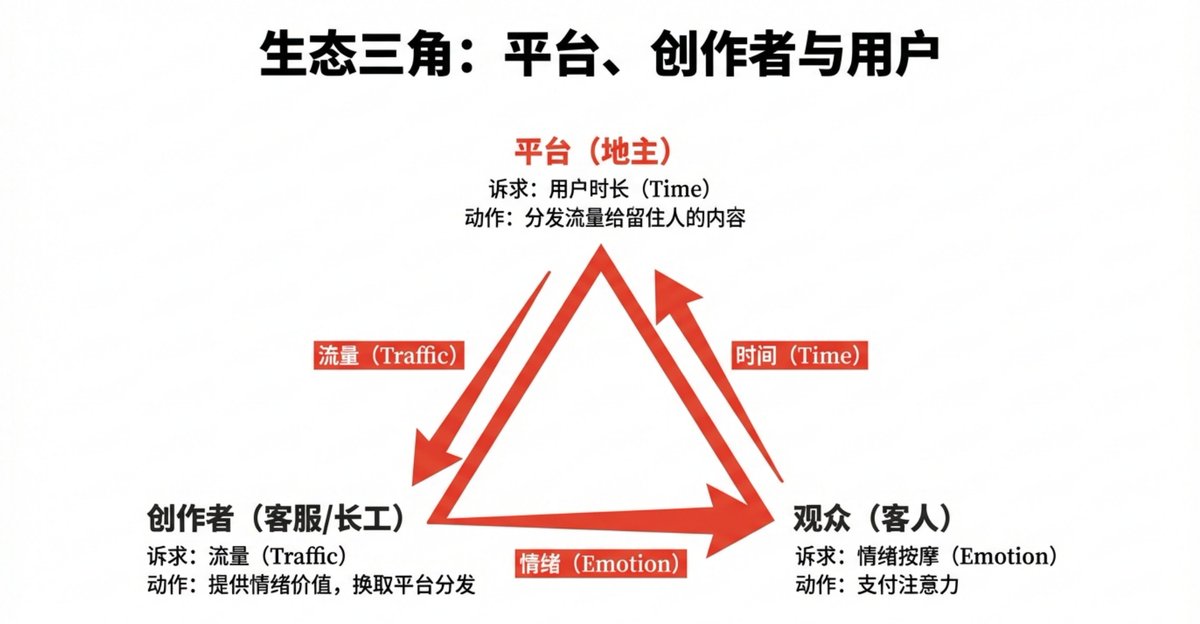
1.2 Platform Logic: We Are the "Workhorses" Laboring for the Platform
Don't think too highly of yourself. The relationship between us and the platform is simple. The platform is the landlord; we are the "workhorses" tilling his land, and the audience are the honored guests the landlord tries everything to retain.
● The Platform's Goal: To squeeze every last bit of time out of users at all costs.
● The Key to Retaining Users: Emotion and story. These are the spiritual opium, the most addictive.
● The Creator's Role: We are the platform's "customer service," or rather, "emotion suppliers." Our core task is to produce the product the audience needs, to "serve these audience masters well." If you make them feel good, the platform can retain them.
As a reward, the platform will then share a bit of traffic with you. This is the naked exchange of interests behind traffic.
1.3 A Key Insight: Users Don't Want Logic, They Want an Emotional Cure
Take "the plunge in gold and silver prices" as an example. When countless retail investors who followed the trend get trapped, filled with fear, regret, and confusion, what do they most want to see?

I found that when the vast majority of people are emotionally charged, they don't need cold solutions. They need emotional validation and an outlet for venting.
Your content must precisely give them psychological comfort or an action reason that lets them "save face." Now that we understand the core of traffic is emotion, how do we create content that accurately conveys emotion?
- Three Core Techniques for Igniting Emotional Content
No empty talk, straight to the practical stuff. The following three techniques are battle-tested insights distilled from countless viral content pieces.
2.1 Technique One: The Title Accounts for 70%, Convey Emotion Instantly
Remember this ironclad rule: The success or failure of an article is at least 70% determined by the title. When users scroll through their feeds, they give you less than a second.
Your title must be like a poisoned hook, instantly snagging the user's emotion. Using the "gold plunge" example again, why did the viral title "Gold Plunge, The Dream is Over, Who Will Pay the Bill?" explode?
● "The Dream is Over": Three words that directly smash the feeling of loss and disillusionment from a shattered get-rich dream onto the user's face.
● "Who Will Pay the Bill?": Five words that precisely poke at the panic, confusion, and scapegoat-seeking psychology in the hearts of those who lost money. This title doesn't analyze a single data point or explain any logic, but it renders a complex emotion to the extreme, making the target user utterly unable to resist clicking.
2.2 Technique Two: Firmly Take a Side to Attract Die-hard Fans
The dumbest thing you can do in self-media is to be a neutral, rational observer or a peacemaker. You must firmly take a side, even if your viewpoint is wrong (or rather, you should always believe you are right).
The traffic mechanism behind this is extremely counter-intuitive:
-
Your clear-cut viewpoint will galvanize those who support you. They will become your die-hard fans, charging into battle for you.
-
Simultaneously, it will infuriate those who oppose you. They will fight you to the death in the comments section.
-
The most crucial step comes next: When the opponents can't out-argue you or want to find allies for support, they will share your article to find comrades to gang up and criticize you.
-
In the eyes of the platform's algorithm, this "negative sharing" is no different from positive sharing; both are manifestations of engagement. As the saying goes, "Make as many friends as possible, and as few enemies as possible." But on the self-media battlefield, we must do the opposite: The more enemies, the better. Every person who criticizes you is contributing traffic to you with their anger.
2.3 Technique Three: The "Cure" Must Outweigh the Method
This is a higher-level strategy and also a form of self-protection: Only provide emotional value and psychological comfort (the cure), never provide specific operational methods. If you give specific methods, you are taking on the "cause and effect" of the user's decision. If they make money, they won't thank you; if they lose money, they will absolutely come back to curse your ancestors for eighteen generations.
What is our role? To provide a future "scapegoat." Many investors want to sell but are afraid of selling wrong, want to hold but are afraid of further drops, their hearts in agony. Your article gives them a reason to make a decision and, more importantly, gives them an object to shift blame onto.
They can tell themselves: "I sold. If it rises later, I'll blame that damned snail—he advised me to sell!" See, you gave them psychological comfort, allowed them to make their own decision, and provided an emotional outlet for their future regrets.
This is the highest level of emotional value, and you remain unscathed.
Mastering these techniques requires an even more core ability to support them. That is how to cultivate your own "Internet Sense" from scratch.
- How to Deliberately Practice Your "Internet Sense" from Scratch?
"Internet Sense" is not innate. It's a muscle that can be trained to become incredibly strong through deliberate, posterior practice.
3.1 Cultivation Formula: No Shortcuts, Only Deliberate Practice
Don't believe those get-rich-quick lies. The only formula for cultivating Internet Sense is hard work:
-
Watch More: Browse viral content on various platforms daily, like breathing.
-
Write More: Maintain high-frequency creation, forcing yourself to output.
-
Post More: Don't be afraid of poor data; bravely throw your content into the market for testing.
-
Review More: Regularly dissect your own and others' viral hits and flops to find the emotional code behind them.
3.2 A Feasible Practice Method: Perceive Emotion, Don't Analyze Content
Here's a specific practice step you can use immediately: When you see a piece of viral content, restrain the impulse to immediately analyze its structure or golden phrases.
First, ask yourself: "What emotion does this article/video make me feel? (Anger, happiness, fear, or comfort?)" Practice capturing and recording that first, unprocessed emotional trigger. Repeat this action a hundred, a thousand times until it becomes your instinct. When you can instantly name the emotion any content conveys, your Internet Sense is formed.
3.3 The Most Important Mindset: Drop the "Face," Reject "Traffic Purity"
What's the number one factor for doing self-media well? It's not writing skill, not creativity, but shamelessness. Too many creators have a so-called "traffic purity" and "ideological purity" complex:
● They disdain riding trends, thinking it's lowbrow.
● They think what the masses like is too shallow; they want to output something "highbrow."
● They put on airs, unable to let go of that bit of intellectual arrogance. Let me tell you, when you are a nobody, your face is worthless.
The me from the previous year was bound by this "face." It wasn't until I completely figured it out that I had my later enlightenment, and my public account started growing from dozens to hundreds to over a thousand at its peak.
Therefore, I discovered that to do self-media well, please grab your face, put it in your pocket, or even stick it to the sole of your shoe.
When someone comments, "With your level, you still come to the platform to beg?" I can laugh and reply: "Sorry, I didn't even finish elementary school. I'm indeed here to beg. Boss, care to tip?"
When you can do this, your content truly sheds its shackles, gains "spirit," and can resonate with the broadest public emotions.
"Internet Sense" is not mysticism; it's an emotional perception ability that can be mastered through deliberate practice. Its core is the complete shift from "What do I want to express?" to "What does the public need?"
With that, I wish all you Yifeis and Yanzus explosive articles and early achievement of the 1M-read milestone.