Beginner
The $150K/Year Job I Do with a $500 AI: A Personal Business Agent Upgrade Guide
The $150K/Year Job I Do with a $500 AI: A Personal Business Agent Upgrade Guide
The $150K/Year Job I Do with a $500 AI: A Personal Business Agent Upgrade Guide#
During the 2026 Lunar New Year, I made a decision: to fully agent-ify my entire business workflow.
One week later, this system is already running about 1/3 of the way. Even though it's still being perfected, my daily routine tasks have been reduced from 6 hours to 2 hours, while my business output has increased by 300%.
More importantly, I validated a hypothesis: the agent-ification of personal business is feasible, and I believe everyone should build such an operating system.
Having an agent system means a fundamental shift in your thinking—from "how do I complete this task" to "what kind of agent should I build to complete this task." The impact of this shift from passive to active thinking is enormous.
In this article, I won't output any AI-generated motivational fluff or deliberately create anxiety about AI replacement. Instead, I will thoroughly break down how I completed this transformation step by step, and how you can replicate this method for free.
This is the first article in the series on building an agent productivity system. Click save now to follow future updates without getting lost.

Why Agent-ification is a Must, Not an Option#
Let's start with a harsh truth:
If your business model is "trading time for income," then your income ceiling is locked in by the laws of physics. There are only 24 hours in a day. Even if you work non-stop all year, the upper limit of hourly billing is right there.
- Fund manager annual salary ¥1.5 million ≈ ¥720 per hour (based on 2080 working hours)
- Consulting partner annual salary ¥2 million ≈ ¥960 per hour
- Top finance KOL annual income ¥3 million ≈ ¥1440 per hour
Seems high? But this is already the limit of the human-powered model.
The logic of agent-ification is completely different: your income is no longer determined by your working hours, but by the operational efficiency of your system.
A Real Turning Point
One Friday night in January 2026 at 11 PM, I was still at my computer sorting through the day's market data.
The US stock market had crashed that day. I needed to:
- Read 50+ important news items
- Analyze the after-hours performance of 10 key companies
- Update my investment portfolio strategy
- Write a market commentary article
I calculated it would take at least another 3 hours. And at 8 AM the next morning, I would have to repeat the same process.
At that moment, I suddenly realized: my time wasn't spent on the thinking and decision-making of investment analysis; I was just being a data porter.
The decisions that truly required my judgment probably only took up 20% of my time. The remaining 80% was repetitive information gathering and organization.
This was the starting point of my decision to agent-ify.
My investment research agent system now automatically processes daily:
- 20,000+ global financial news items
- 50+ company earnings report updates
- 30+ macroeconomic data indicators
- 10+ industry research reports
To complete this work manually would require a team of 5 people. My cost is: $500 per month in API call fees + 1 hour of my review time per day.
This is the essence of agent-ification: using algorithms to replicate your judgment framework, and using API costs to replace labor costs.
01 Deconstruct Your Business: The Three-Layer Architecture from Human to System#
Any knowledge work can be broken down into three layers:

Layer 1: Knowledge Base
This is the agent's "memory system."
Taking investment research as an example, my approach was to build a knowledge base containing the information and data I need for investing, including:
-
Historical Database
- Macroeconomic data from the past 10 years (Fed, CPI, Non-Farm Payrolls)
- Earnings data for the top 50 US-listed companies
- Post-mortem notes on major market events (2008 financial crisis, 2020 pandemic, 2022 rate hike cycle)
-
Key Indicators & News
- Major financial media and information channels I follow
- Fed policy and key company earnings release dates
- 50 Twitter accounts I follow (macro analysts, fund managers)
- Important macroeconomic indicators
- Important industry research and industry data tracking
-
Personal Experience Base
- My investment decision records from the past 5 years
- Post-mortems on the accuracy of each judgment
A Concrete Case: The Market Crash in Early February 2026
In early February, the market suddenly crashed: gold and silver plummeted, cryptocurrencies gushed, and US, Hong Kong, and A-shares plunged one after another.
The main interpretations in the market were:
- Anthropic's legal AI is too powerful, software stocks crashed
- Google's capital expenditure guidance was too high
- The incoming Fed Chair Warsh is a hawk
My agent system issued a warning 48 hours before the crash because it detected:
- Japanese bond yields spiking, US2Y-JP2Y spread narrowing significantly
- TGA account balance high, Treasury continuously draining liquidity from the market
- CME raising gold and silver futures margins for 6 consecutive sessions
These were clear signals of tightening liquidity. And in my knowledge base, there was a complete post-mortem on the market volatility triggered by the unwinding of the yen carry trade in August 2022.
The agent system automatically matched the historical pattern and gave a "tight liquidity + high valuations → reduce positions" recommendation before the crash.
This warning helped me avoid at least a 30% drawdown.
This knowledge base has over 500,000 structured data points, with 200+ automatically updated daily. Maintaining it manually would require 2 full-time researchers.
Layer 2: Skills (Decision Frameworks)
This is the most easily overlooked but most critical layer.
Most people use AI like this: open ChatGPT → input question → get answer. The problem with this approach is that AI doesn't know what your judgment criteria are.
My approach is to break down my decision logic into independent Skills. Taking investment decisions as an example:
Skill 1: US Stock Value Investing Framework
(The following Skills are examples and do not represent my actual investment criteria, which are also updated in real-time)
Skill 2: Bitcoin Bottom-Fishing Model
Skill 3: US Stock Market Sentiment Monitoring
Skill 4: Macro Liquidity Monitoring
The essence of these Skills is: making my judgment criteria explicit and structured, allowing AI to work according to my thinking framework.
Layer 3: CRON (Automated Execution)
This is the key to making the system truly operational.
I set up the following automated tasks:

Now my morning looks like this:
7:50 AM: Wake up, check phone while brushing teeth. The agent has already pushed the overnight global market summary:
- US stocks rose slightly last night, tech stocks led gains
- Bank of Japan kept rates unchanged, yen depreciated slightly
- Oil prices rose 2% due to geopolitics
- Today's focus: US CPI data, NVIDIA earnings
8:10 AM: Eat breakfast, open computer for detailed analysis. The agent has already generated today's strategy:
- CPI data expected to meet market expectations, neutral impact on market
- NVIDIA earnings key focus: AI chip order guidance
- Recommendation: Hold tech stock positions, watch energy sector opportunities
8:30 AM: Start work. I only need to make the final decision based on the agent's analysis: whether to adjust positions, and by how much.
The entire process takes 30 minutes.
I no longer need to frantically flip through news every morning; AI has already done the prep work for me.
More importantly, investment decisions are no longer easily swayed by emotions. Instead, they are based on a complete investment logic, clear judgment criteria, and are reviewed, summarized, and iterated upon based on performance. This is the correct path for investing in the AI era, not continuing to hire a bunch of interns to update Excel profit forecast tables every day, or going all-in with 50x leverage based on gut feelings, waiting for a miracle.

02 Agent-ification of Content Production: From Handicraft Workshop to Production Line#
My second main business is content creation, currently primarily on Twitter (X), and also exploring YouTube and other video formats.
Previously, my general process for writing an article was:
- Find a topic (1 hour)
- Research materials (2 hours)
- Write (3 hours)
- Revise (1 hour)
- Publish + interact (1 hour)
Total: 8 hours per article, with unstable quality.
I reviewed the biggest problems with my previously published articles, mainly:
- Topics too broad, no specific angle
- Content too theoretical, lacking concrete cases
- Titles not attractive enough
- Publishing timing
Integrating agent-ification into content production is a project that can be systematized!
Therefore, my agent-ification transformation for content is in three steps:

Step 1: Build a Viral Content Knowledge Base
I did something many people overlook: systematically study the patterns of viral articles.
Specific approach:
- Scraped the Top 200 viral articles in the finance/tech space on platform X over the past year.
- Used AI to analyze their commonalities: title structure, opening methods, argument logic, ending design.
- Extracted reusable "viral formulas."
A few examples:
Title Formulas:
- Number Impact Type: "After My Assets Shrank 70%, I Realized..."
- Counter-intuitive Type: "The Internet is Dead, Agents are Eternal"
- Value Promise Type: "Save You... No Need to Buy on Xianyu"
Opening Formulas:
- Start with a Specific Event: "In January 2025, I made a decision..."
- Extreme Contrast: "If you continue at your current pace... but 6 months later..."
- Break Then Build: "There are several interpretations in the market... I think all of the above are wrong"
Argument Structure:
- ViewpointData Support → Case Validation → Counter-argument
- Clear layering using 1/2/3
- Professional terms + plain language explanations
I organized these patterns into a "Viral Content Framework Library" and fed it to the AI.
Step 2: Human-AI Collaborative Content Production Line
Now my content production process has become an efficient human-AI collaborative production line, with clear division of labor at each stage.
Topic Selection Stage (AI-led, I decide)
Every Monday morning, my agent automatically pushes 3-5 topic suggestions.
Input sources:
- This week's global market hot topics (automatically scraped)
- My investment research notes and latest thoughts
- High-frequency discussion topics on social media
- High-frequency questions from reader comments
AI output format:
I choose the topic that best fits the current market sentiment and where I have unique insights.
Research Collection Stage (AI executes, I supplement)
After selecting a topic, the agent automatically initiates the research collection process:
-
Data Scraping (Automated)
- Latest earnings data of relevant companies
- Historical trends of macroeconomic indicators
- Core viewpoints of industry research reports
- Representative opinions on social media
-
Information Organization (AI processing)
- Categorize scattered information according to argument logic
- Extract key data and citation sources
- Generate a preliminary argument framework
-
Manual Supplementation (My value-add)
- Add my personal experience and cases
- Supplement niche information sources the agent can't find
- Mark which viewpoints need emphasis in argumentation
This stage shortened from the original 2 hours to 30 minutes.
Writing Stage (Human-AI Collaboration)
This is the most critical stage, with a very clear division of labor between me and the AI:
AI is responsible for:
- Generating article structure based on the viral framework
- Filling in data and factual content
- Generating multiple title and opening versions for selection
- Ensuring the completeness of argument logic
I am responsible for:
- Injecting personal viewpoints and value judgments
- Adding real cases and details
- Adjusting tone and expression
- Deleting AI-generated "correct but useless fluff"
Revision Stage (AI-assisted, I lead)
After the first draft is complete, I have the agent do a few things:
-
Readability Check
- Are sentences too long (sentences over 30 words highlighted in red)
- Is there repetitive expression?
- Do professional terms need explanation?
-
Viral Element Check
- Does the title follow high-engagement patterns?
- Do the first 3 paragraphs have hooks?
- Is there specific data support?
- Are there quotable golden sentences?
-
Multi-version Generation
- Generate 3 titles with different styles
- Generate 2 endings from different angles
- I choose the most suitable version
This stage shortened from the original 1 hour to 15 minutes.
Publishing Stage (Automated)
After the article is finalized, the agent automatically executes:
- Convert to formats for various platforms (X/WeChat Official Account/Xiaohongshu)
- Generate image suggestions (generated after my confirmation)
- Automatically publish at the optimal time (based on historical data analysis)
Step 3: Data-Driven Continuous Optimization
Key insight: A content agent is not a one-time build, but a continuously evolving system.
I do a weekly review:
- Which type of title has the highest save rate?Update title formula weights
- Which argument structure gets the most shares?Strengthen this template
- What do readers most often ask in comments?Add to FAQ, address in next article
A concrete example:
I found that "data-intensive" articles (lots of specific numbers + charts) had a 40% higher save rate than pure opinion articles. So I adjusted the content framework, requiring AI in the first draft to:
- Each core argument must have at least 1 data point supporting it
- Each article must contain at least 3 charts
- Data sources must be cited
Result: The average save rate for the last 5 articles increased from 8% to 12%.
In January 2026, I wrote an article titled "In the Era of the Agent Explosion, How Should We Deal with AI Anxiety?"
This article didn't have much data, but the share rate was unusually high, reaching 20%.
I had the agent analyze the reasons and found:
- The article touched on deep value questions (AI vs. human meaning)
- Used the specific scenario "Save the cat or the famous painting if the Louvre is on fire?"
- The ending "It's important to become someone who better uses AI, but more importantly, don't forget how to be a human" resonated.
I added this finding to the framework library: appropriately adding philosophical reflection and value discussion in technical articles can significantly increase share rates.
This is the compound interest effect of an agent system: the system is helping me optimize the system. A content agent is also not a one-time build that ends, but a continuously evolving system.
03 From Personal Capability to Consulting Services: Validating the Replicability of the Methodology#
After I got my own investment research and content agent systems running smoothly, I started thinking: Can this method help others?
Last December, I had a meal with a fund manager friend. He said he was overwhelmed. He manages a private equity fund of about 500 million, with nearly 10 people under him, but still felt dragged around by market news, exhausted every day.
His daily work rhythm was like this:
- Wake up at 6:30 AM, check overnight global markets
- 7-8 AM: Review overnight global market key news
- 8:30-9:30 AM: Morning meeting, discuss investment strategy
- 9:30 AM-3 PM: Monitor the market, handle trades
- 3-6 PM: Research companies, read earnings reports
- 6-8 PM: Write investment log, review
- 10 PM: Watch overseas market open
I helped him do a workflow analysis and found:
- 60% of time spent collecting and organizing information (can be agent-ified)
- 20% of time spent on repetitive analysis (can be agent-ified)
- 15% of time spent making decisions (human-AI collaboration)
- 5% of time spent on trade execution (can be automated)
So I spent two weeks helping him build a simplified version of an investment research agent:
- Week 1: Interview his workflow, identify agent-ifiable stages
- Week 2: Build knowledge base + configure 3 core Skills + set up automated tasks
Two weeks later, he sent me a WeChat message: "Having more time to think has made my investment mindset much steadier."
This project made me realize: The demand for agent-ification transformation is widespread. Compressing information processing time is increasing investment efficiency.
But I quickly discovered that doing pure consulting has two problems:
- Time bottleneck: Each project takes 2-4 weeks, I can take on at most 3 projects a month.
- Not scalable: Each client's needs are different, hard to standardize.
This made me start thinking about the next stage: from service to product.
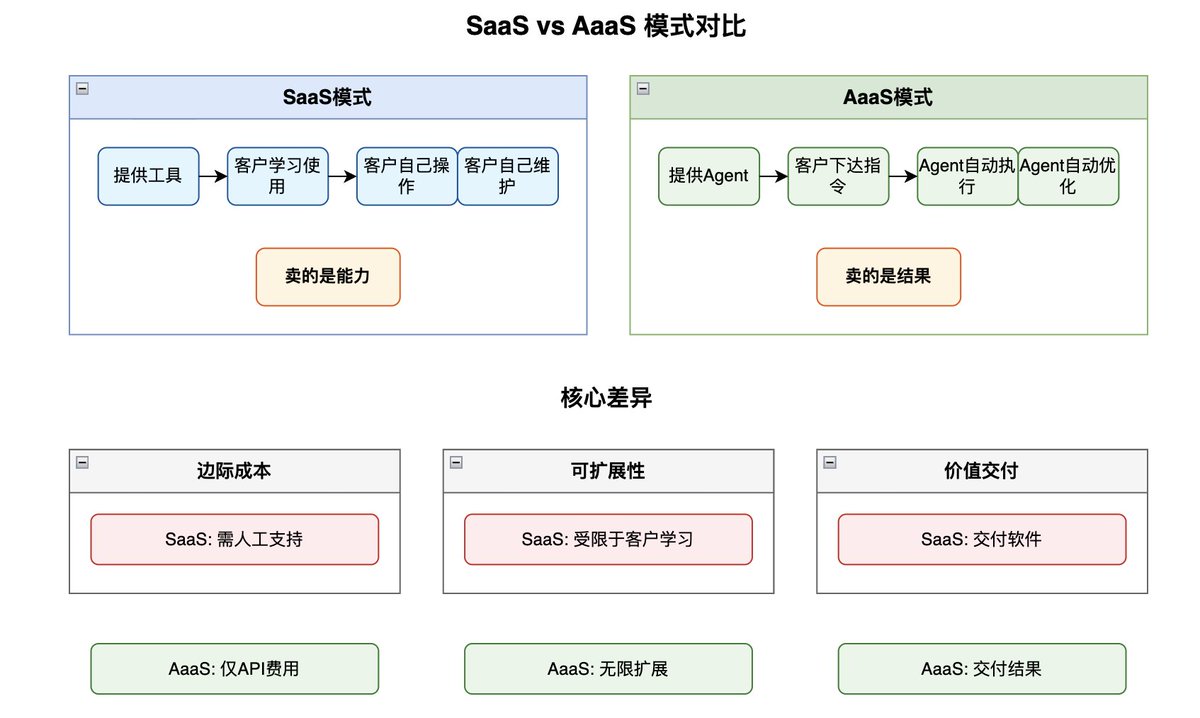
04 Agent as a Service: The Paradigm Shift from SaaS to AaaS#
Traditional software is SaaS (Software as a Service):
- You give the client a tool
- The client needs to learn how to use it
- The client operates and maintains it themselves
The future is AaaS (Agent as a Service):
- You give the client an Agent
- The client only needs to give instructions
- The Agent automatically executes and optimizes
The difference is: SaaS sells "capability," AaaS sells "results."
In January this year, I had another meal with that fund manager friend.
He said: "The agent system you helped me build is so useful. I recommended it to a few peers, and they all want it. But you doing consulting alone, how many clients can you serve?"
I said: "Indeed, that's a problem."
He said: "Why don't you turn it into a